Foreign exchange for international business: rates, fees, risks, and global payments
Learn where currency conversion occurs in international payments, how rates and total costs are determined, who absorbs FX exposure, and how to control costs, reconcile transactions, and evaluate providers.

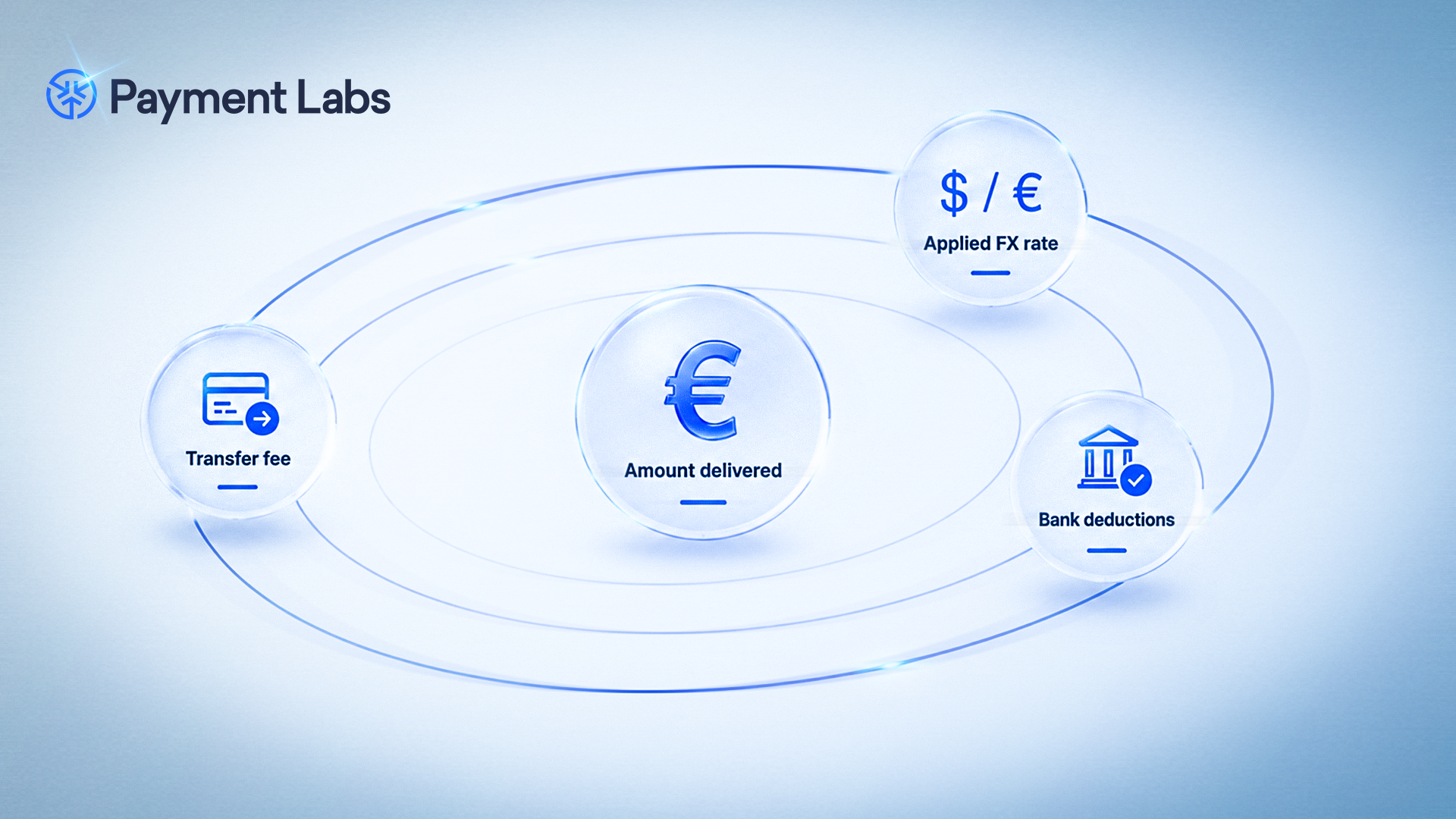
Foreign exchange can occur at several points in an international payment flow. The currencies used to price, fund, settle, and deliver a payment determine where conversion takes place, which rate applies, and whether the customer, business, or recipient absorbs the cost.
A business paying a fixed amount in USD has a different exposure from one promising each recipient a fixed amount in local currency. The same payment can also produce different results depending on when the rate is set, how the provider prices the conversion, which payment rail is used, and whether an intermediary or receiving bank makes another deduction.
That is also why the headline exchange rate does not show the payment’s total cost. Businesses need to look at the complete transaction: the amount funded, the amount delivered, the rate applied, the fees charged, and any additional conversion along the way.
This guide walks through:
- How currency conversion works within an international payment
- How the exchange rate applied to a payment is set
- The full cost of an international payment and who absorbs it
- Choosing a currency strategy and controlling FX costs
- Reconciliation and accounting for foreign-currency payments
- Regulatory considerations when using foreign exchange
- Evaluating an FX and international payment provider
How currency conversion works within an international payment
Receiving international payments
For card payments, the business submits the charge in the currency shown at checkout. If that differs from the cardholder’s billing currency, the card network and issuer handle the conversion unless the customer accepts a conversion offered at checkout. On the merchant side, the acquirer or payment provider either settles the transaction currency or converts the proceeds into the business’s settlement currency.
Bank transfers can be converted by the sender’s bank before transmission, by the business’s payment provider after collection, or by the receiving bank. Businesses using local collection accounts can accept funds in the customer’s currency and convert them later. If the destination account cannot hold the transferred currency, the receiving bank may convert the funds or reject or return the transfer.
Making international payments
For payouts to athletes, creators, contractors, rights holders, vendors, or other recipients, the business sets either the amount it will fund or the amount to be delivered. If the funding and payout currencies differ, the provider calculates the corresponding amount when the rate is set.
The provider may convert the funds before initiating a local-currency payout, giving the business visibility into the delivered amount. Alternatively, it can send the payment internationally and leave the final conversion to an intermediary or receiving bank. In that case, the applied rate and final local-currency amount fall outside the provider’s control.
How the exchange rate applied to a payment is set
The exchange rate depends on the institution that converts the funds. That can be the card issuer, card network, payment provider, sending bank, or receiving bank. If conversion is left to an intermediary or recipient bank, the business often has limited visibility into the rate before the payment is delivered.
Providers generally price the conversion using a market rate plus a spread or markup. The final rate depends on the currency pair, liquidity, transaction size, execution time, route, and the business’s pricing agreement. Some pairs can be converted directly, while others are routed through USD, EUR, or another intermediary currency.
A quoted rate is often only indicative until the payment is funded or the conversion is executed. A locked rate applies for a specified amount and period. Late or incomplete funding can cause the quote to expire and the payment to be repriced.
The full cost of an international payment and who absorbs it
The quoted exchange rate does not show the full payment cost. Depending on the payment path, the total cost may include:
- Provider conversion markup
- Transfer or transaction fees
- Cross-border fees charged separately from the transfer fee
- Correspondent bank deduction
- Receiving-bank fees
- A second conversion by an intermediary or receiving bank
- Fees or rate differences if the payment is returned or reversed
Some charges are billed separately, while others are deducted from the payment principal.
Cost allocation depends largely on which amount is fixed.
When a business invoices or pays in its own currency, the customer or recipient usually absorbs the conversion cost and any movement in the local-currency equivalent. When the business commits to an exact amount in local currency, its funding requirement changes with the rate.
Take a $10,000 endorsement payment to an athlete based outside the US. Assume FX pricing reduces the delivered value by 1.5% and transfer fees total $100. If the brand fixes the send amount at $10,000 and the costs are deducted from the payment, the athlete receives approximately $9,750 in value. If the brand instead fixes the receive amount at $10,000, it must fund approximately $10,250.
Costs increase when a payment passes through an intermediary currency or the receiving bank converts the funds again. Returned payments can also incur additional fees and be converted back at a different rate. The relevant comparison is therefore the total amount debited against the amount ultimately credited, not the FX markup in isolation.
Choosing a currency strategy and controlling FX costs
Currency strategy should be set by payment flow and corridor rather than applied uniformly across the business. The main decisions are which amount to fix, where to hold balances, when to convert, and whether conversion should occur before the payment enters the destination market.
- For incoming payments, collecting and settling in the same currency lets the business hold the proceeds, use them to meet obligations in that currency, or choose when to convert them.
- For outgoing payments, converting centrally and initiating a local-currency payout usually provides greater control over the delivered amount than leaving conversion to an intermediary or receiving bank.
FX exposure begins when the business commits to an amount in a currency that does not match the funds available to meet it. It ends when the required currency is acquired or the rate is fixed through a binding transaction.
The provider with the lowest markup may not have the lowest total cost. Route, timing, downstream deductions, and the ability to reuse existing currency balances can have a greater effect on the final result.
A few practices tend to keep FX costs and exposure in check:
- Matching incoming and outgoing obligations in the same currency
- Holding currency balances instead of converting every receipt
- Setting fixed-send or fixed-receive rules by payment program
- Converting before payout rather than leaving conversion downstream
- Comparing complete corridor costs, not just the quoted rate, across routes
- Defining rate tolerances and approval thresholds
- Locking rates when approval, funding, and execution do not occur together
- Consolidating conversions when the pricing benefit outweighs the added market exposure
- Monitoring rate, fee, and delivered-amount variances by currency and provider
Reconciliation and accounting for foreign-currency payments
A payment can be processed at one rate and get recorded in the books at another. The accounting entry can be created when an invoice is issued or an obligation is recognized, while conversion and settlement occur later.
When a payment gets flagged in reconciliation, these are the fields that actually let you explain the discrepancy:
- Original transaction amount and currency
- Funding amount and currency
- Converted amount and settlement currency
- The rate applied and when the conversion happened
- Markup and any other fees charged on the conversion
- Dates for settlement and delivery
- What the customer or recipient actually received
- Any intermediary or receiving-bank deductions, if visible
- Rates and fees applied to returns or reversals
Reconciliation only works if FX movement, payment costs, and operational variances remain separate. A gap between expected and delivered amounts may result from a rate change, provider fee, downstream deduction, partial payment, or second conversion. Combining these into one unexplained variance makes it difficult to identify the cause or compare corridor and provider costs accurately.
Foreign-currency transactions are usually recorded in the business’s accounting currency. If the exchange rate changes between the date the transaction is recorded and the date it is settled, the difference is often recognized as an exchange gain or loss. The exact treatment depends on the applicable accounting framework, such as IFRS (International Financial Reporting Standards) or US GAAP (Generally Accepted Accounting Principles), and the business’s reporting obligations.
Regulatory considerations when using foreign exchange
AML screening, KYC, payment-message requirements, regulatory reporting, and licensing for the conversion and transmission itself generally sit with the bank or payment provider. But the business must still provide accurate counterparty and payment-purpose information and confirm that its provider is authorized for the relevant markets.
Businesses making or receiving cross-border payments also need to consider:
- Sanctions and trade restrictions - the business must ensure that the transaction, counterparty, country, and underlying goods or services are permitted. US businesses are subject to OFAC sanctions, while EU businesses must comply with applicable EU restrictive measures. Provider screening does not remove the business’s responsibility for the transaction.
- Currency controls - some countries require payments to pass through authorized institutions and may impose purpose codes, supporting-document requirements, conversion restrictions, or central-bank reporting.
- Data protection - international payments often involve names, bank details, tax records, and identity documents. Where the GDPR applies, businesses need a lawful basis for processing this data, appropriate retention and security controls, clear responsibilities with payment providers, and a valid transfer mechanism when data moves outside the EEA (European Economic Area).
- Tax and recordkeeping - businesses need to retain the currencies, amounts, rates, dates, and fees required to report revenue, expenses, withholding, and exchange gains or losses. Additional account-reporting obligations may apply. For example, US persons with qualifying foreign financial accounts may have FBAR obligations. These arise from the accounts held, not simply from converting currency.
- Customer-facing conversion disclosures - if customers are offered a currency-conversion choice at checkout, the business should confirm which party is responsible for presenting the rate and markup. In the EU, Regulation (EU) 2021/1230 imposes specific disclosure requirements on providers of certain card-based currency-conversion services.
Evaluating an FX and international payment provider
Compare providers using the same currencies, amount, funding method, payment rail, and delivery requirements.
Before signing with a provider, find out:
- How rates and conversion fees are calculated
- When a rate is locked and what can cause repricing
- Whether the funding or delivered amount is guaranteed
- Which currencies can be funded, held, converted, and paid out
- Which local and international rails are available by corridor
- Whether intermediary or receiving-bank deductions apply
- How returns, reversals, and failed payments are handled
- Support for multi-currency balances, approvals, batch payments, and APIs
- The rates, fees, timestamps, and payment statuses available for reconciliation
- The provider’s compliance coverage and support for delayed or rejected payments
Tracking rates, fees, and deductions should continue after implementation.
Payment Labs combines currency conversion, global payouts, tax compliance, reporting, and payment support in one platform. Payment Labs dynamically routes payments through available local and international rails to reduce total transaction costs across 180+ countries and 150+ currencies. Contact us to discuss your international payment requirements.